
What a Chinese Perfume Factory Costs a Subscription Brand
A subscription perfume brand buys the same scent many times over, in smaller batches, and that single fact rearranges which factory costs matter. Tooling, moulds and artwork setup shrink in importance across a long relationship, while filling tolerance, batch-to-batch consistency and packaging durability grow. The useful way to read a Chinese factory quote is therefore not to ask what the unit costs, but to ask which lines behave differently when a formula is produced repeatedly. The seven lines below cover almost everything that can be quoted, and each one has a question attached that a repeat programme needs answered.
Key takeaways
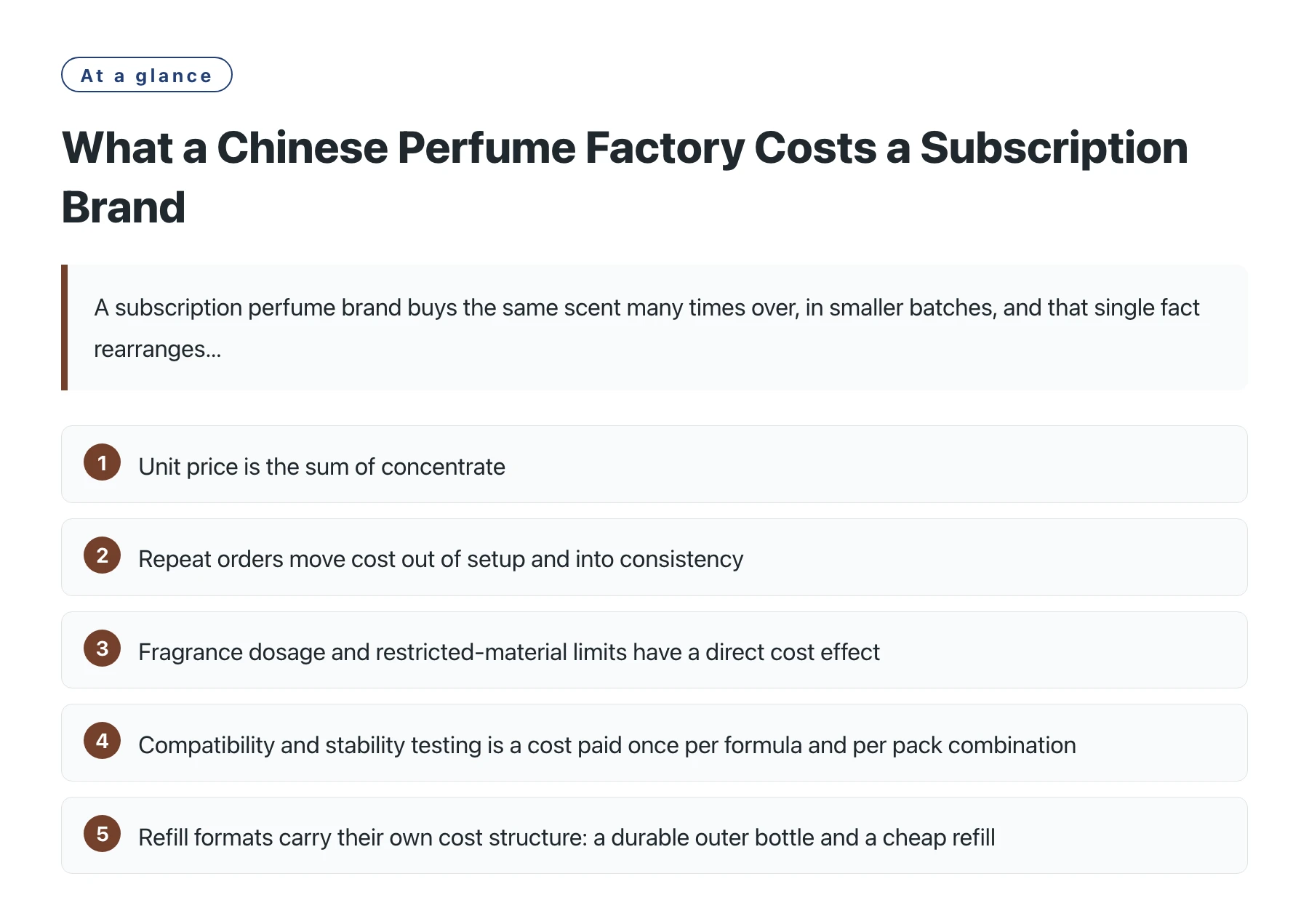
- Unit price is the sum of concentrate, fill ingredients, packaging, decoration, filling, testing and freight, so a quote that names only one of those lines cannot be compared with another quote.
- Repeat orders move cost out of setup and into consistency, which is why the reference sample, the fill tolerance and the packaging specification matter more to a subscription brand than to a seasonal launch.
- Fragrance dosage and restricted-material limits have a direct cost effect, because a formula approved at its use ceiling leaves no room for a cheaper substitution later [1].
- Compatibility and stability testing is a cost paid once per formula and per pack combination, and it is cheaper to budget at the brief stage than to discover during a launch [2].
- Refill formats carry their own cost structure: a durable outer bottle and a cheap refill, which changes how decoration and assembly should be split.
- Ask for the quote in line items with volumes attached, because a price per unit without a fill weight, a packaging definition and a volume is not yet a price.
Subscription selling is becoming a normal way to buy fragrance: a starter bottle, then a refill on a schedule, with the scent chosen once and repeated. That shape of business puts a premium on the unglamorous parts of manufacturing, because the same liquid, the same fill and the same spray have to arrive again and again without the customer noticing a difference.
Fragrance factories in southern China suit that pattern, since the supply chain for bottles, pumps, caps and cartons sits close together and small repeat runs are routine rather than exceptional. The catch is that a quote written for a one-off launch and a quote written for a repeat programme do not follow the same logic, and comparing them line for line produces misleading conclusions about who is cheaper.
What follows is a walk through where the money actually goes in a Chinese factory quote, which lines deserve a subscription brand's scrutiny, and which questions turn a vague quotation into a document that a planning calendar can be built on.
Where the money goes, line by line
| Cost line | What drives it | What a subscription brand should pin down |
|---|---|---|
| Fragrance concentrate | Dosage, material cost and the complexity of the accord | Price per kilogram at the agreed dosage, plus what happens if a material becomes restricted [1] |
| Alcohol and other fill ingredients | Grade, duty treatment and fill volume | Whether the fill is identical across the range and how it is checked on arrival |
| Bottle and closure | Glass weight, mould ownership, pump or crimp type | Who owns the mould, what the smallest run is, and how the refill pack differs from the starter pack |
| Decoration | Print method, number of passes, colour matching | Whether decoration is priced per unit or per run, and what setup is charged again on a reorder |
| Filling and assembly | Line speed, fill tolerance, how many steps are manual | A fill weight tolerance in writing and the leak or spray check performed on every batch |
| Testing | Which tests, on which combinations, run by whom | A named test list per formula and per pack, with the laboratory identified [2] |
| Freight and duties | Incoterm, transport mode, destination rules | Which party is importer of record and which documents travel with the goods |
A quote built from these seven lines can be compared with another quote, and it also shows where a subscription brand's real exposure sits: not in the first order, but in the third and fourth, when a reorder either repeats cleanly or reopens a commercial conversation. It is also the shape of answer that makes screening a perfume manufacturer China candidate straightforward rather than a negotiation.
Three costs that only show up on the second order
The first order is the easy one. The formula is fresh, the team is paying attention, and the reference sample is sitting on a desk in the brand's office. Repeat orders are where a subscription business earns or loses its margin, and three cost lines behave differently there. Seeing that clearly starts with a reading a perfume price breakdown that separates fixed lines from variable ones, because the two move in opposite directions as volume rises.
Consistency has a price, and it is worth paying
Filling a formula to the same strength every time takes either a larger batch or tighter process control. A factory compounding in small kettles may need to group a subscription brand's reorders to reach an economical batch size, which is a scheduling reality rather than a fault. Ask how reorders are grouped, what the smallest sensible run is, and what happens in a month when demand falls below it. That answer decides whether a monthly cadence is realistic or whether the brand should ship every second month.
Packaging decisions lock in early and cost later
A refill programme needs a durable outer component and a cheap inner one, and the split between them is a design decision with a cost consequence. Decorating both halves doubles the decoration line; decorating neither can weaken the shelf presence that wins the first order. Price three variants before choosing: decorated outer with a plain refill, plain components with a printed label, and a single decorated bottle with no refill at all. The comparison usually shows that the refill saving is smaller than expected unless the outer bottle is genuinely reused several times.
Restricted materials remove options
Fragrance materials carry use restrictions that depend on the product category, and a formula approved at the ceiling has no headroom. When a limit tightens or a material becomes harder to buy, the reformulation cost lands on the brand, which then has to re-approve the scent and re-test the pack. Keeping a margin below the limit is a form of insurance, and it is one of the few technical questions worth settling before the brief is closed [1].
One practical test of any quotation: ask the factory to price the same product at three volumes and to say which lines stay fixed and which scale. A supplier that answers quickly is usually working from a real cost model, while one that returns the same per-unit figure at every volume is working from a guess. For a subscription brand the interesting number is the smallest volume at which the fixed lines stop dominating, and it is worth comparing that answer across two or three candidates before committing to a private label perfume production in China route.
Sources
- IFRA Standards Library (International Fragrance Association) —— The IFRA Standards Library lists the restrictions the fragrance industry applies to individual fragrance ingredients, based on safety assessments; it is the reference point for compliant fragrance formulation.
- SGS: Cosmetics, Personal Care & Household Testing —— Testing, inspection and certification services for cosmetics and personal care, including microbiological, stability and safety testing aligned with cosmetics GMP.
Frequently asked questions
How do I compare two Chinese perfume factory quotes fairly?
Insist that both quotes use the same fill weight, the same packaging definition and the same volume, then compare line by line rather than per unit. Where one quote excludes decoration, testing or freight, add those costs back in first, because an excluded line is the most common reason a quote looks cheaper than it really is.
Why does a subscription brand care about fill tolerance?
Because the brand repeats the same promise every month. If the fill weight drifts, the customer eventually notices either a bottle that empties faster or a spray that behaves differently, and the complaint lands on the brand rather than the factory. A written tolerance and a per-batch check are what keep the promise stable.
Are repeat orders much cheaper than the first order?
Some lines fall away, such as artwork setup and first-run approvals, while most others stay. Filling, decoration and assembly are largely variable, so a reorder is usually cheaper but not dramatically so, and the fixed costs that remain should be named in the original quote rather than discovered later.
What should be in writing before a subscription programme starts?
The formula and its dosage, the filling tolerance, the packaging specification, the test list per formula and pack combination, the reorder minimum, and the terms that govern a price change. Those six items are what make the second year of a subscription business predictable instead of reactive.
Does a refill format always reduce unit cost?
No. Refills reduce material and decoration on the inner pack, but they add an outer component that has to be durable, plus the logistics of handling two items. The saving is real when the outer bottle is reused several times and the refill stays simple, and it can disappear when both halves are decorated.
Treat the MBA as a deliberate career investment.
Walsh MBA engineers positioning, narrative, and interview performance for executives who refuse to settle for average. Forty clients a year. No exceptions.
Book My Strategy Call