
Brass Jewelry Supplier Vetting: Six Questions
Six answers separate a brass supplier that can repeat an order from one that can only quote it: alloy and temper, the true count behind the minimum, coating build, compliance scope, the sampling calendar and who owns the tooling. The published benchmarks make each answer checkable — 100 pieces per design on artisan eco-brass, CAD inside 48 hours, master samples in 25–30 days and bulk runs of 3–4 weeks.
Key takeaways
- 100 pieces per design is the artisan eco-brass minimum, and the count is per design, not per order.
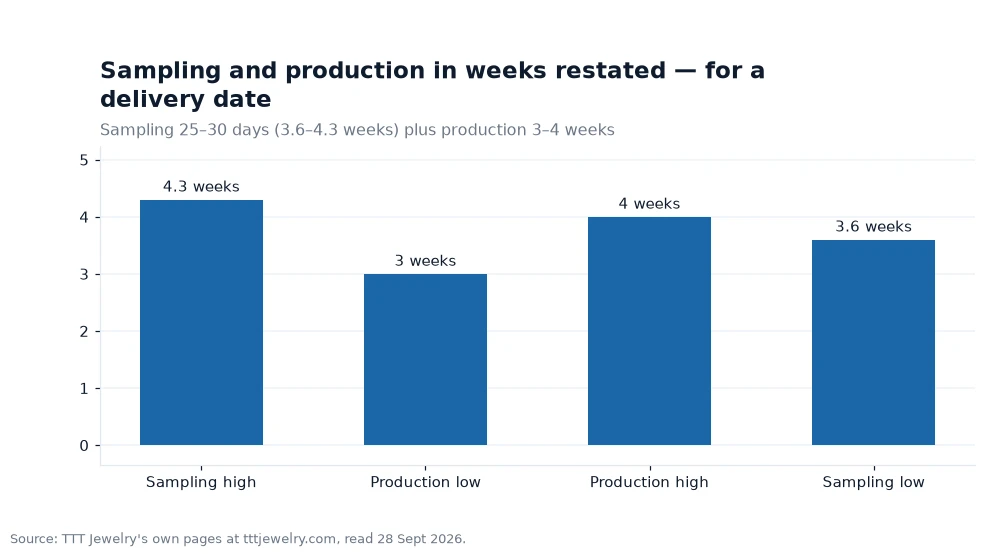
- Master sampling runs 25–30 days, or 3.6–4.3 weeks, before the 21–28 day production window opens.
- Silver sits at 50 pieces per design, exactly half the brass threshold, so small silver pilots are easier to place.
- A coating answer without a layer order cannot be tested, priced or defended after a tarnish complaint.
Question one: which alloy, and at what temper?
Buyers new to custom brass jewelry ask about colour first. Colour is the visible variable, but it sits downstream of two decisions that are far harder to reverse: alloy and temper. The published brass line is artisan eco-brass, a copper-zinc material worked at a bench rather than stamped at speed, with the finish applied after forming.
Temper describes how hard the metal is when it reaches the saw or the press. A shank holding a stone needs enough stiffness not to creep under load. A hinged bangle needs enough ductility to close without cracking at the knuckle. One alloy can arrive in more than one temper, and a supplier that cannot name the temper for a specific component is working from habit rather than from a specification.
Ask for the alloy designation and the temper per component, not per order. Three parts in a single design may need three answers: a cast pendant, a drawn wire hoop and a stamped plate are different starting points even when the metal is nominally the same. Undocumented variation surfaces months later as a shank that bends or a hinge that loosens.
Weight sits beside temper. Two pendants with the same footprint can differ in metal content depending on whether they are cast solid or struck from sheet, and the plating bath has to cover whatever surface the design creates. A brief that states grams and minimum thickness gives the sample bench a target to hit.
Question two: what does the minimum actually count?
The MOQ on artisan eco-brass is 100 pieces per design. The last two words do the work. Six designs at 100 pieces is a 600-piece commitment, while a new colourway on an existing design may or may not reset the count, depending on whether plating counts as a variant or as a new build.
Ask how the number is counted — per SKU, per design family, per metal lot — then ask what happens below it. Some factories will run one pilot under the threshold; others hold the line. Either answer is workable, but it needs to be known before a seasonal plan rests on it.
Compare that figure with the silver threshold of 50 pieces per design. Silver is exactly half the brass minimum, so a small first order in 925 sterling silver commits fewer units than the same styles in brass, even though the metal costs more per gram. Buyers who assume the cheaper metal carries the lower entry point have the arithmetic backwards.
Write the number into the purchase order and into the reorder clause. A minimum that lives only in an email thread tends to drift upward when the account changes hands.
Question three: what sits on top of the brass?
Artisan eco-brass takes an anti-tarnish e-coating, and the plating menu lists multi-layer 14K, 18K and 24K gold alongside rhodium. Each option is a different sequence of tank passes, and the e-coat is one more pass over the top.
The real question is what the coating has to survive. An earring worn against skin, a cuff rubbed by a shirt sleeve and a pendant that hangs outside clothing present three different wear problems. REACH and CA Prop 65 compliance covers restricted substances in the plating, not the number of months a layer will last, so compliance and durability need separate answers.
Ask for the layer order in writing. Gold directly on brass, gold over a barrier layer, and gold over an e-coat all photograph the same and behave differently after a season. The layer order is also the reference point for any complaint: without it, a tarnish report cannot be tied to a process step.
Paperwork depth shows here. The brass line's get quote form asks for material, quantity and finish together, because those three answers choose the process route before a price means anything. A supplier that quotes before asking for them is quoting a guess.
Questions four to six: compliance, calendar, ownership
Compliance means ISO 9001:2015 for process control across production stages, BSCI for labour practice, and REACH plus CA Prop 65 for the metal and its coating. Ask for certificate numbers and for the scope each one covers, then check whether plating is inside that scope or only assembly.
| Question | Weak answer | Evidence to request |
|---|---|---|
| Alloy and temper | "It is brass" | Alloy designation and temper per component |
| Minimum quantity | "Around 100" | Count basis: SKU, design or metal lot |
| Coating build | "Gold plated" | Layer order and whether an e-coat is used |
| Compliance | "We are certified" | ISO 9001:2015 scope, REACH and Prop 65 statements |
| Calendar | "A few weeks" | CAD under 48 hours, sampling 25–30 days in writing |
| Mould ownership | "It is yours" | NDA terms plus a no-resale clause for moulds and CAD |
The calendar answer has a published shape: CAD under 48 hours, master sampling 25–30 days, then bulk production of 3–4 weeks, with every piece inspected before delivery. A supplier that cannot put those three windows in writing is describing a schedule rather than managing one.
Ownership is the answer most often left verbal. Designs are stated as 100% exclusive, with moulds, CAD files and the collection not resold or shown to other buyers. That promise is worth exactly as much as the clause that carries it, so ask for the NDA and the exclusivity language before the first sample is cut.
Worked example
Take a buyer planning four brass designs at the published 100-piece minimum. The commitment is 4 × 100 = 400 pieces. Placed in 925 sterling silver at 50 pieces per design instead, the same four styles would commit 4 × 50 = 200 pieces, half the unit count for identical design work. Silver costs more per gram; brass costs more per launch.
Now the calendar. CAD is quoted at under 48 hours, which is 2 days. One sampling round at 25–30 days equals 3.6–4.3 weeks. Bulk production at 3–4 weeks equals 21–28 days. Added end to end: 2 + 25 + 21 = 48 days at the fast end and 2 + 30 + 28 = 60 days at the slow end, the familiar 7–9 week range.
A second sampling round inserts another 25–30 days, moving the same four-design order to 73–90 days. On a four-design launch that single extra round decides whether goods ship inside the quarter or after it, which is why the sample brief is worth more attention than the sample date.
Frequently asked questions
Is 100 pieces the minimum for every brass design?
At the published artisan eco-brass threshold the minimum is 100 pieces per design, so several styles multiply the total rather than sharing one minimum between them.
How long does a brass sample take?
CAD is quoted at under 48 hours and master sampling at 25–30 days, so a first physical sample usually lands within five weeks of a complete brief.
Does an anti-tarnish coating replace gold plating?
No. The e-coating is a protective pass on silver and brass, while 14K, 18K, 24K gold and rhodium provide the colour and barrier layer that sits under it.
Scoring the answers before the first sample
A supplier that answers five of six questions in writing and hedges on the sixth is usually hedging on the one that will hurt. Score each reply against the published figures rather than against the sales deck: 100 pieces, 25–30 days, a named coating stack, a certificate scope, a mould clause.
Buyers building a repeat programme can compare the brass route with the wider custom jewelry wholesale structure, where tooling already exists and the per-unit arithmetic improves on reorder. Where the factory develops the concept rather than producing a supplied CAD file, the OEM/ODM jewelry manufacturer model is the fairer comparison, because design hours sit inside the programme instead of on the buyer's side of the ledger.
Settle ownership before the first invoice. A mould clause costs nothing to negotiate at the start and cannot be recovered later.
Source note: figures come from the manufacturer's own website (tttjewelry.com), read 28 Sept 2026.[1]